


We’ve got ourselves a new cabinet, a brand new South African government; anything could happen. It’s all subjunctive, it’s all ‘what if this happens’, or ‘why didn’t they…’, that’s what history is, subjunctive. Like the course of any human life, a series of verbs denoting acts that affect consequences. An election is the perfect time to contemplate ourselves, both our future and our past. The past isn’t really conducive to good health, particularly with our country’s history. It’s currently the vogue for autobiographical material to be laden with virtue-signaling; everyone claims they had no idea what was going on, or that the author’s ancestry is impeccably moral – all crusaders for liberty, equality, and fraternity.

What I’m going to blather on about today follows on my posts about therapeutic writing [read it here] – and my attempt to jolt myself out of anhedonia and creative block by returning to a disciplined blogging habit through Stream of Consciousness writing [read it here]. This blathering is prompted by my word of the day: autoethnographic.
Autoethnography is a form of ethnographic research in which a researcher connects personal experiences to wider cultural, political, and social meanings and understandings. It is considered a form of qualitative and/or arts-based research. Autoethnography has been used across various disciplines, including anthropology, arts education, communication studies, education, educational administration, English literature, ethnic studies, gender studies, history, human resource development, marketing, nursing, organizational behavior, paramedicine, performance studies, physiotherapy, psychology, social work, sociology, and theology and religious studies.
Historically, researchers have had trouble reaching a consensus regarding the definition of autoethnography. However, it generally refers to research that involves critical observation of an individual’s lived experiences and connecting those experience to broader cultural, political, and social concepts. Autoethnography can refer to research in which a researcher reflexively studies a group they belong to or their subjective experience. In the 1970s, autoethnography was more narrowly defined as “insider ethnography,” referring to studies of the (culture of) a group of which the researcher is a member. According to Adams et al., autoethnography uses a researcher’s personal experience to describe and critique cultural beliefs, practices, and experiences; acknowledges and values a researcher’s relationships with others uses deep and careful self-reflection—typically referred to as “reflexivity”—to name and interrogate the intersections between self and society, the particular and the general, the personal and the political shows people in the process of figuring out what to do, how to live, and the meaning of their struggles balances intellectual and methodological rigor, emotion, and creativity strives for social justice and to make life better.
Should we teach the Holocaust? Alan Bennett asks in The History Boys. Should we similarly try to relate the horror of South African history to a new generation? Graham Collier cautions that “…there is a natural tendency with age to live too much in the past – reminiscing and contemplating. It is all too easy as one ages to mentally ‘wander off’ into a stream of memories, dreams, and reflections unrelated to the moment, yet which insist on dominating consciousness as they flit across the screen of the mind (the ‘Been There; Seen This; Done That…’ sort of attitude).”
Carl Sagan put it well, “One of the saddest lessons of history is this: If we’ve been bamboozled long enough, we tend to reject any evidence of the bamboozle. We’re no longer interested in finding out the truth. The bamboozle has captured us. It’s simply too painful to acknowledge, even to ourselves, that we’ve been taken. Once you give a charlatan power over you, you almost never get it back.”
Does chasing the truth in history matter?
Does my own truth about my own life matter; can I unravel the bamboozle?
It matters rather a lot, according to Bukowski:
I now write from an old mind and an old body, long beyond the time when most men would ever think of continuing such a thing, but since I started so late I owe it to myself to continue, and when the words begin to falter and I must be helped up stairways and I can no longer tell a bluebird from a paperclip, I still feel that something in me is going to remember…how I’ve come through the murder and the mess and the moil, to at least a generous way to die. To not to have entirely wasted one’s life seems to be a worthy accomplishment, if only for myself.
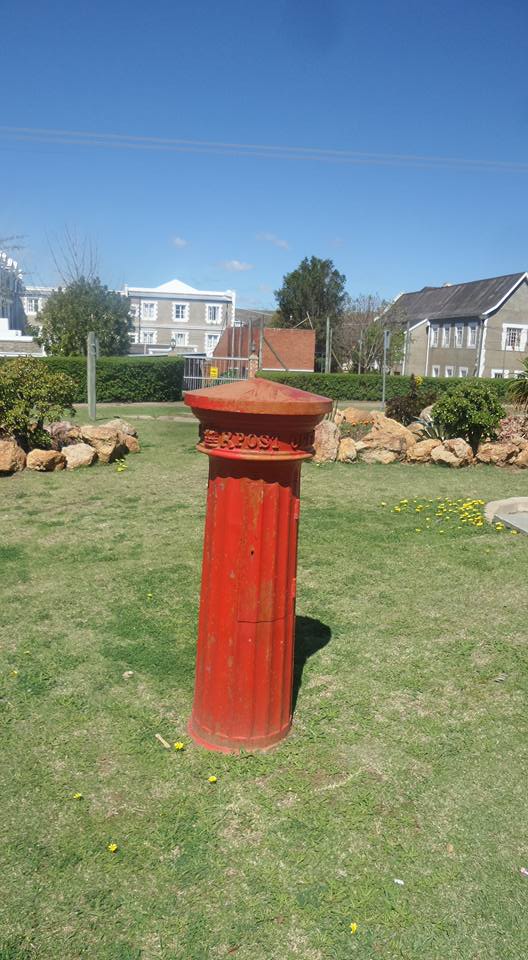
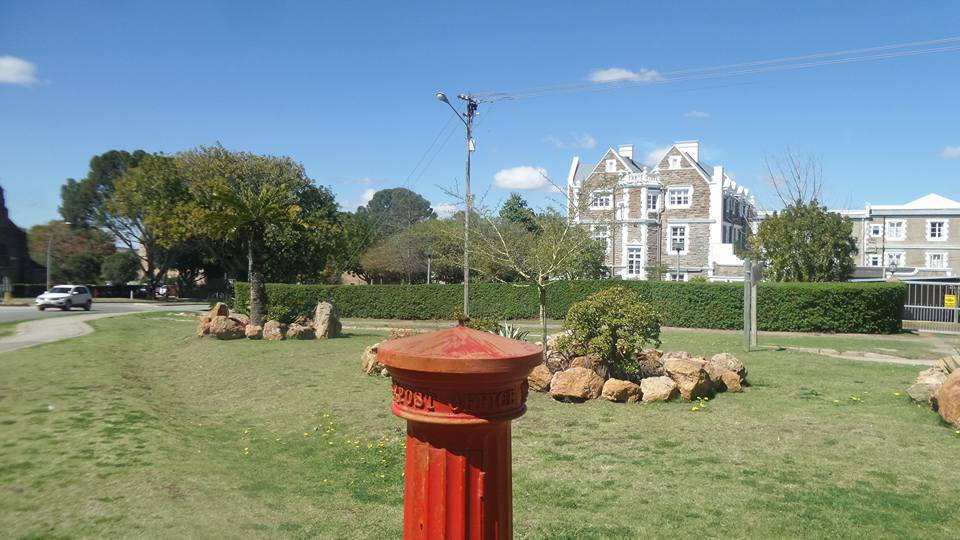
Pics are mine, of the oldest official letter box in South Africa, in Makhanda / Grahamstown. This box is painted in the traditional post office red and manufacture dates back to between 1857 and 1859. It no longer displays the letters “V.R” denoting the monarch, Queen Victoria, as this was stolen many years ago.
SOURCES & FURTHER READING
Ellis, Carolyn (2004). The Ethnographic I: A Methodological Novel About Autoethnography. Walnut Creek, CA: AltaMira Press. ISBN 0-7591-0050-0. OCLC 52845847.
Adams, Tony E.; Jones, Stacy Holman; Ellis, Carolyn (2015). Autoethnography. New York, New York: Oxford University Press. ISBN 978-0-19-997210-4. OCLC 891397276.
Leavy, Patricia (2020). Method Meets Art: Arts-Based Research Practice (3rd ed.). The Guilford Ford. ISBN 978-1-4625-3897-3.
Maréchal, Garance (2010). “Autoethnography”. In Mills, Albert J.; Durepos, Gabrielle; Wiebe, Elden (eds.). Encyclopedia of case study research. Volume 2. Los Angeles [Calif.]: SAGE. pp. 43–45. ISBN 978-1-4522-6572-8. OCLC 811140520.
Reed-Danahay, Deborah (2009-02-20). “Anthropologists, Education, and Autoethnography”. Reviews in Anthropology. 38 (1): 28–47. doi:10.1080/00938150802672931. ISSN 0093-8157. S2CID 143711383.
Zheng, Shiyu (2019-12-26). “A Multi-methods Approach in Communication Studies”. Comunicación y Métodos. 1 (2): 196–208. doi:10.35951/v1i2.43. ISSN 2659-9538.
Bohonos, Jeremy; Duff, Myron C. Jr. (2020-12-09). “Adult Education in Racialized Spaces: How White Supremacy and White Privilege Hinder Social Justice in Adult Education”. Dialogues in Social Justice: An Adult Education Journal. 5 (2). ISSN 2578-2029.
Starr, Lisa J. (2010-07-06). “The Use of Autoethnography in Educational Research: Locating Who We Are in What We Do”. Canadian Journal for New Scholars in Education. 3 (1). ISSN 1916-9221.
C. Collins, Joshua; W. Bohonos, Jeremy (2021), “Phenomenology and autoethnography as potential methodologies for exploring masculinity in organizations, communities and society”, Handbook of Research Methods on Gender and Management, Edward Elgar Publishing, pp. 265–280, doi:10.4337/9781788977937.00027, ISBN 9781788977937, retrieved 2021-12-17
Bohonos, Jeremy W (2021-06-03). “Workplace hate speech and rendering Black and Native lives as if they do not matter: A nightmarish autoethnography”. Organization. 30 (4): 605–623. doi:10.1177/13505084211015379. ISSN 1350-5084. S2CID 236294224.
McIlveen, P. (2007-12-06). “The Genuine Scientist-practitioner in Vocational Psychology: An Autoethnography” (PDF). Qualitative Research in Psychology. 4 (4): 295–311. doi:10.1080/14780880701522403. ISSN 1478-0887. S2CID 143663430.
McIlveen, P.; Beccaria, G.; du Preez, Jan.; Patton, W. (2010). “Autoethnography in Vocational Psychology: Wearing Your Class on Your Sleeve”. Journal of Career Development. 37 (3): 599–615. doi:10.1177/0894845309357048. S2CID 142958143.
Witkin, Stanley L. (2022). “Autoethnography and social work: Strange bedfellows or complementary partners?”. Social Work and Social Sciences Review. 23 (3): 19–35. doi:10.1921/swssr.v23i2.2030. Retrieved 2023-03-29.
Carl Sagan, The Demon-Haunted World: Science as a Candle in the Dark
https://www.psychologytoday.com/us/blog/the-consciousness-question/201707/reminiscing-and-contemplating/Retrieved 9 June 2024.
\ Get the latest news /
