

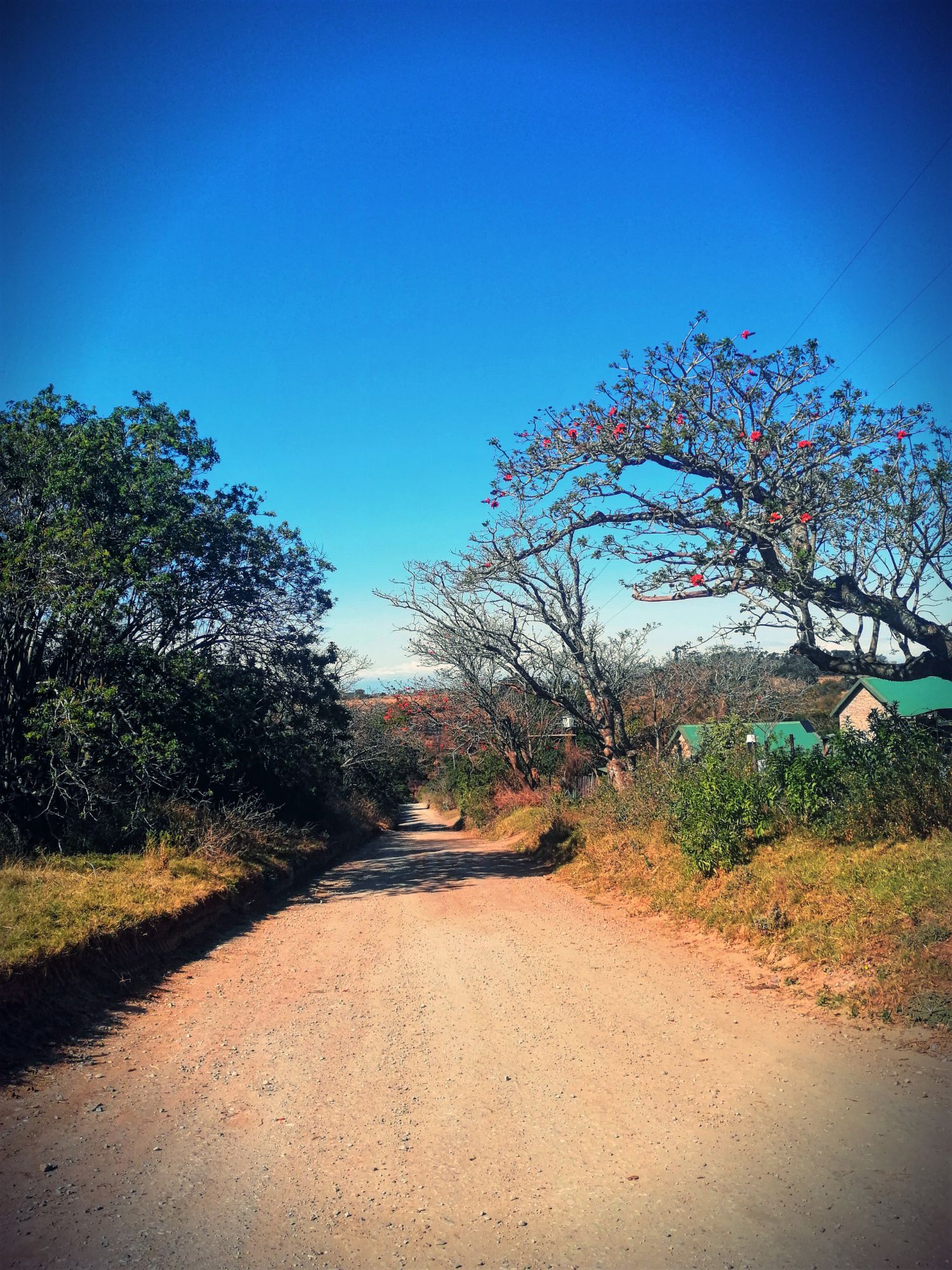
Aesop’s Fables, The World’s Best Known Collection Of Morality Tales (circa 260 BC), provides the first instance of the caution ‘Be careful what you wish for’. I thought of this as I crossed the street to avoid being struck a blow in a clumsy fistfight happening on the pavement between two habitual trouble-makers, both drugged out of their minds and completely unaware of me. It was very early and I took a slow walk with my dog, letting her enjoy a leisurely sniff on the streets before the village kicked into Sunday bustle. We walked to the top of the hill and I looked out at the distant sea, and I chided myself for the millionth time for how I had once romanticized it all.
Throughout my childhood, every year on around the 5th of January, my dad would carefully reverse his Ford Fairlane or Rambler Classic up to the tow bar our Jurgens caravan, hook it up, do the stabiliser brackets thing with lots of knocking his ankles and swearing, gather us with our peeling suntans and seashells into the back seat. Then he would honk his loud hooter twice, and pull us all out of the caravan park to drive us on the fourteen hour journey back inland. One year there was an inexplicably grand Wolesley that had no loud hooter, but had posh wood panelling on the dashboard and a faulty engine that caused a delay in getting out of our home driveway to begin with, causing an argument between the grown-ups. We got going and the Wolesley broke down in the Karoo, which made us spend two nights in Craddock waiting for a mechanic. My mother cursed the British for the entire four weeks of that holiday, and the Wolesley was history as soon as we got home after the hols. My dad would change the subject if that make of car was ever mentioned in polite company in later years. But this isn’t a blog post about cars, it’s about staying at the holiday place forever.
From the backseat of my father’s car, after those magical holidays, I would crane my neck to give a last wave to friends who would stay behind, and keep staring until I lost sight of the resort gates. I was always envious of the local teens who stayed behind; I imagined them carrying on their holiday-job lives as lifesavers, boathouse help, or the most enviable gig of all, the cashier at the ice cream and deckchair kiosk. Part of me retains the dream, still, of owning the ice cream kiosk, but it’s an obsolete and impossible one, given how the South African landscape has changed, along with the very nature of the modern leisure environment.
In most small resort towns along the Eastern Cape’s ‘Sunshine Coast’ today it’s almost impossible to find a traditional job with a viable permanent income of the type that once formed the out-of-season community which these towns depended on for survival. It’s not a recent phenomenon that the party lifestyle of casual workers hired for a season eats up their wages, and often the result is a homeless beach bum begging outside the boarded-up ice cream kiosk for drug money through the winter months. Knots of drifters feed the drug trade, and a general seediness contaminates everything, not least the community psychology as a whole.
It’s not a problem endemic to South Africa, of course, Heather Hansman[i] of Moscow-Pullman Daily News writes that “Ski towns have some of the highest suicide rates in the country, and social services haven’t expanded to meet demand. Racial gaps are also widening in an industry that often depends on undocumented immigrants to fill the poorly paid, but necessary, jobs it takes to keep a tourist town running.”[ii] She ends by pointing out that most resort towns “some of the most elite and economically unequal places in the country—are microcosms for the way our social fabric is splitting.” As the song goes,
And the women tug their hair
Like they’re trying to prove it won’t fall out
And all the men are gargoyles
Dipped long in Irish stout
The whole place is pickled
The people are pickles for sure
And no one knows if they’ve done more here
Than they ever would do in a jar
This could be Rotterdam or anywhere
Liverpool or Rome…[iii]
There’s an air of impermanence in a holiday town, a restless mood prevails. Aside from the bums, the permanent communities cling like aphids to bar counters out of season, fearful of the future, inclusive, and suspicious. Gossip becomes currency for buying a thrill, substance use is common extending also to abuse of recreational and prescription drugs, and alcoholism is rife. Death by suicide is significantly more prevalent in rural areas than in urban areas, according to research done by Judith Casant and Marco Helbich in a 2022 literature review. [iv]
With surprising insight for one so young, Shura Hanna, a computer scientist in Canada explains her experience of “Small Town Sydrome” growing up in the Bahamas:
If I had to give a clear analogy of how it feels to be stuck in a small town, I’d say it parallels the process of a snake shedding its skin. You feel out of place in your current surroundings so you feel the need to be elsewhere. Unfortunately, it’s not that simple and it’s an uncomfortable feeling. In films, small towns are portrayed as close-knit, slow-paced communities where everybody knows everybody. As a person that grew up in a place where most of the population is either distantly related or knows each other’s family lineage from generations far gone, it’s very endearing. It provides the mental security of predictability.
Most people here attended the same small selection of elementary, middle, and high schools. The people at the local grocers know shoppers by name because they’ve been around since childhood. Pastimes typically don’t exceed more than a handful of activities (not including drinking and smoking — which are done a concerning amount but who cares because what else is there to do). Opportunity is far and few between. Living and growing up is almost formulaic and the people are most likely just like you. They have morals, values, and a sense of ‘normalcy’ that is similar to your own.
It just makes sense, right? Well, I guess. Here’s the thing:
The bubble we’ve grown up in supposedly encapsulates all things right and anything outside of that is subject to scrutiny. Thin veils of kindness are worn on the faces of those who pry your troubles out of you to create gossip later on. People are openly discriminatory with little to no care as to how it affects others. Those who don’t fit a particular mold are treated like outcasts by the population…Soon enough you realize that you don’t share similar interests with your old friends, and new ones are hard to come by in a place so secluded.[v]
By the time I got down the hill with my dog, the fighting gutter snipes had moved off, chased away by the café owner, the hotel was putting out cheerful cloths on the outside tables for the tourists, and good people were filing into the little church for the morning service. I came inside and read the news online, and I saw that things aren’t better in Rotterdam, or Liverpool, or anywhere alone, for that matter. As Doris Lessing said, “The art of living in a small town is one of the most difficult to acquire.”
Wherever you find yourself, you gotta make your own kind of music, I guess.
FURTHER READING / REFERENCES:
[i] HEATHER HANSMAN is an award-winning freelance writer and a former editor at both Powder and Skiing magazines. She’s Outside magazine’s environmental columnist and a contributing editor at Backcountry Magazine.
[ii]https://dnews.com/opinion/her-view-the-mountain-ski-bum-culture-hits-reality/article_6bb09c6b-a0dd-58dd-b9fd-32eca06c91cc.html
[iii] Songwriters: Paul Heaton / Dave Rotheray, Rotterdam lyrics © Island Music Ltd.
[iv] Casant J, Helbich M. Inequalities of Suicide Mortality across Urban and Rural Areas: A Literature Review. Int J Environ Res Public Health. 2022 Feb 25;19(5):2669. doi: 10.3390/ijerph19052669. PMID: 35270369; PMCID: PMC8909802.
[v] Extracts (condensed) from: https://medium.com/new-writers-welcome/small-town-syndrome-why-home-isnt-where-my-heart-is-7e10ecdedf1b
\ Get the latest news /

The second last paragraph resonates with wherever you live be it a small town or a large city or even just your local area. The human is but a strange thing, difficult to understand at the best of times.