

“There was some women in a café the other week that I was sat in, and she came up and she sat down with her mate and she was talkin’ loudly goin’ on about “oh the baby’s lovely.” They said it’s got, er, lovely big eyes, er, really big hands and feet. Now that doesn’t sound like a nice baby to me. I felt like sayin’ it sounds like a frog. But I thought I don’t know her, there’s only so much you can say to a stranger. I don’t know what kept me from sayin’ it.” Karl Pilkington
As a young man, my dad was a compositor in the printing industry – an all-round man on the floor who proofread, typeset, and did the photo lithography. It ruined reading anything other than pulp fiction for him in later years, even when he had long had a different career away from printing. He’d get stuck on the same page for ages until he threw the book aside in frustration. Read it backwards, every sentence, every word, and you’ll find all the mistakes hidden in the flow of the writing. That’s just one of the tips he gave me when my school homework began to include essays. The unfortunate task of calling out the artist’s bullshit cursed my father by placing the burden of strictness on his reading with fact checking joining the list of assaults on the author; the editor must tell the author that the 2l Coke bottle did not exist in the landscape of their 1960s memoir. Some authors take badly to this, but the editor will first make sure that the author does not condescend to the reader, and so it goes. Editors are seldom the darlings once a manuscript is fit for submission to a publisher. Still, the editor is a necessary evil, like it or not.
Online aids to editing yourself are profuse and tend to be generously shared. Tips from literary editing, to formatting and technical expertise are free. However one feels about AI, it’s not to be ignored. Apps like Grammarly and Reedsy have been useful to many of my writer friends. Don’t be intimidated; use the internet for good. Technology can help to build a word count, (AI is for a different discussion). Once you find your groove with that, the editor role should comfortably trot alongside calling you on your bullshit. The point is that you can learn to write by learning to edit.
There is no better way to start than through writing short pieces before attempting a book – be it fiction, memoir, or academic work. Journaling via personal blog, for example, can link you with a hive mind of fellow novice authors and next thing you’ll be writing regularly, and getting free constructive feedback.
For my online friends who are going to try the excellent free monthly prompt from https://deadlinesforwriters.com/ remember that obsessive research may lead you down a rabbit hole, but there are a few things AI won’t do for you – at least not yet, so do the homework. OVERHEARD is an old trope, as old as mankind:
Eavesdropping is also synonymous with different forms of spying. This is not something new, but the methods for eavesdropping have become intensified with the electronic means of communication and recording developed during the last few decades. It is now possible to eavesdrop on a broad range of our daily, sometimes even most intimate activities, like writing mail or even taking notes. Surveillance cameras have become part of the urban landscape, not necessarily tracing my particular route in the city, but certainly being able to reconstruct it if necessary. See footer notes for source.
Examples of gossip/eavesdropping in literature:
Scenes of eavesdropping or of ‘noting’ as it has frequently also been termed can be seen as a multifaceted and multivalent ‘nothing’, as Shakespeare would have it in his play Much Ado about Nothing, referring to illicit or concealed forms of overhearing that lead to “much ado”. In such scenes usually a male spectator inside the fictional world, hiding behind a curtain, an ‘arras’ (or some kind of ‘screen’), or even under a table, is inevitably drawn into the action ‘again’, while becoming radically affected or changed by what he has ‘noted’, frequently even paying with his life for this subversive action. Eavesdropping is a ‘nothing’ (or a non-presence) with dire consequences, exposing strong desires as well as causing much ‘trouble’, following Judith Butler’s understanding of the notion of ‘trouble’, which like in Hamlet, with Polonius hiding behind the arras, involves a ‘closet’ (in Hamlet it is Gertrud’s closet) as the point of origin for philosophical thinking (Butler 1990).
“I will have the children read Hamlet as soon as it is practical. There are some useful cautions against eavesdropping to be gleaned from that.” maryrose wood, The Mysterious Howling
Jean Rhys’s short story, I Spy a Stranger, is made entirely of gossip, where the subject of the character assassination doesn’t even appear to defend herself on the pages. Tony Walker’s audiobook reading of this Jean Rhys masterpiece is magnificent, and he gives a valuable short talk after the reading:
The ear to the keyhole is common in Fine Art; a theme enjoyed particularly by the Victorians: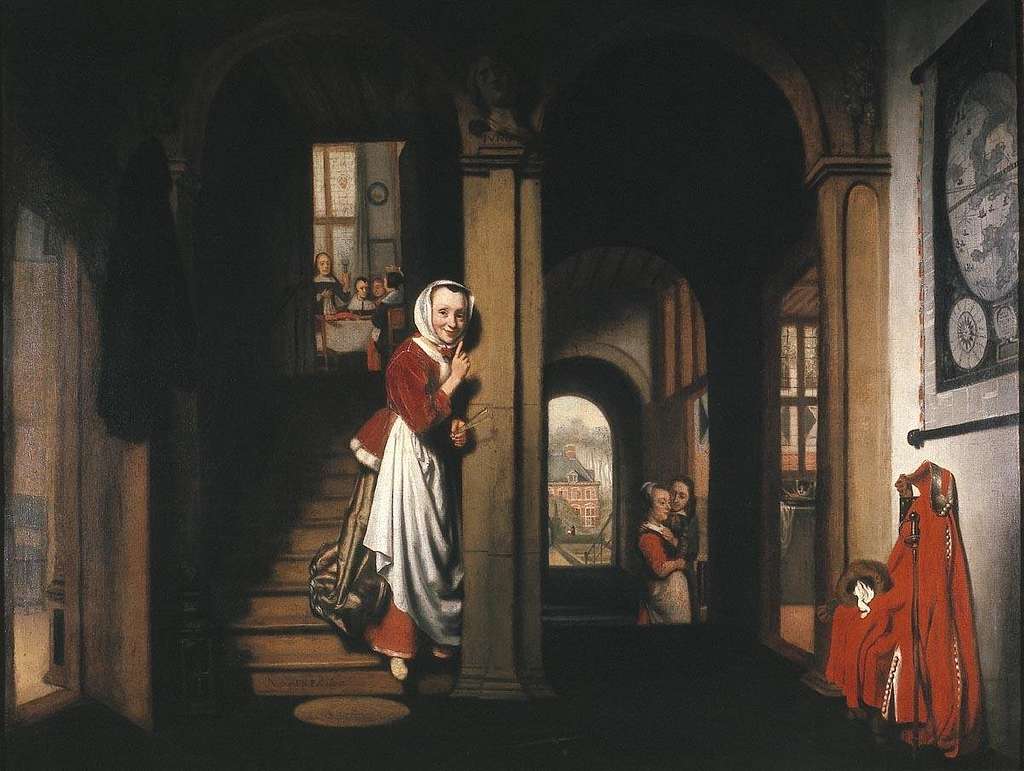
Knut Alfred Ekwall (3 April 1843, Säby Parish (now Tranås), Småland – 16 April 1912, Tranås) was a Swedish painter and illustrator.

Adriano Cecchi 1850-1936 Rococo scene Public domain photograph related to music, performing arts, free to use, no copyright restrictions image – Picryl description
In all genres of Music there is ample material about the consequences of ‘listening to the voices on the wind’, from Marvin Gaye hearing things through the grapevine, to the more sinister implications to Dr. Feelgood’s Roxette:
The music played so loud that I could hear you through the crowd
You was telling everyone about a new guy you’d found
Roxette I gotta go away and leave you for a couple of days
Roxette, I don’t want no more of your tricks, I’m gonna get some concrete mix
And fill your back door up with bricks…
[“Roxette” ; Single by Dr. Feelgood ; from the album Down by the Jetty ; Released, November 1974 (1974-11). Lyrics by Wilco Johnson]
More: https://www.theguardian.com/music/2011/jul/14/readers-recommend-songs-eavesdropping-results
There are consequences to what is done with the information gained by ‘overhearing’, however the information is gained, so before you take your character into the courtroom, DO THE RESEARCH! When a character has secret information, the risks become manifold, notably in Law:
As communications tools expand beyond that of the traditional fixed line telephone, so too do the tools for monitoring those communications. Fuelled by dual needs to protect the privacy rights of individuals, as well as monitor the activities of criminals using the communications networks, governments around the world are toning their surveillance laws in accordance with technological developments and constitutional necessity. In the South African context, the clash of rights inherent in this activity warrants an examination of the continued constitutional status of the Interception and Monitoring Prohibition Act of 1992, in light of recent proposals by the Law Commission to amend its provisions. It is argued that whilst the target of such a law justifies its existence, the reach of its ambit potentially displaces its ongoing constitutional validity.
https://theconversation.com/top-court-ruling-on-south-africas-spy-law-is-a-victory-for-privacy-but-loopholes-remain-154865
“Whatever you do, don’t make it worse by trying to come up with some flimsy excuse for why you were in the ventilation shaft, Lina told herself.”
― Jaleigh Johnson, The Secrets of Solace
You can also look at these:
Ask A Ghostwriter – Eavesdropping Scenes
https://www.rrindex.com/topics/eavesdropping.htm
\ Get the latest news /
